+ Her Barefoot Heart

Category: Jeanne’s Barefoot Heart (Page 14 of 99)

Jeanne’s personal creative pursuits of stories stitched, written, and spoken

81: Milestones Gone Awry

AdaJeanneHawaii2004

There are several milestones in a girl’s life, like leaving the little whiter-than-white frilly lacy fold-down socks behind and donning stockings. One spring, everybody in my 12-year-old Baptist Sunday School class – Dianna, Ginger, Elender, Pam, Jean, Jane, Joan, Susan, Linda, MaryLynn, Mary – fell all over themselves telling me that their mothers were letting them wear stockings on Easter Sunday.

“Are y’all telling me the truth?” I asked them through narrowed eyes. I’d known every one of them since the cradle.

“Yeah, really. Mama said I could wear stockings on Easter Sunday, and I didn’t even have to ask her,” they assured me, each in turn. Ginger added “Is your mama gonna’ let you wear hose or do you still have to wear those little girl socks?” and stuck her tongue out at me for good measure.

I relayed the information to Mother, and because she (a) heard it 15 times an hour for three weeks straight, (b) knew each of the other girls and mothers involved, and (c) could not bear the thought of her daughter being ostracized she eventually said “Okay, Jeanne. Since you’re my favorite daughter, You can wear hose to Sunday School and church on Easter.”

We went to Alford’s (the groceries/furniture/toys/clothes/lawn mower/everything store in town) to buy my garter belt and stockings, then Mother and I did a little bonding as she gave me a lesson in how to slide the little rubber plug into the hook to hold the top of the hose in place gave me a little pamphlet that told me in words and diagrams how to use the garter belt and she went outside to work in her flowers. Every morning, I opened that box with the shiny pink paper on top to eye the folded-up stockings, and every night before I went to bed, I took the lid off that box with the shiny pink paper on top and eyed those stockings.

Easter morning dawned crisp and sunny, and I sang all the favorite Easter hymns – Christ Arose!, He Lives!, Irving Berlin’s Easter Parade! – as I rolled those stockings down, pulled them over my toes, then unrolled them all the way up to my thighs and the waiting garter belt. I put on my white patent leather shoes, and as a bonus, Mother said since I was old enough to wear hose, I could put the strap behind the heel instead of wearing it over my arch. Two things ticked off of my Milestone Bucket List on the same day. Life was good.

Mother pulled that aircraft carrier sized Oldsmobile into a parking place, and since that was the year she taught the 14-year old girls Sunday School class, we walked into the Ingram house then into the Sunday School assembly together. I could feel all eyes on me as I strutted strolled walked down the aisle to take my seat with my classmates . . . and this time all eyes really were on me.

On my legs and feet, to be more specific.

It all happened so fast.

Feeling a little giddy with the enormity of becoming a young woman right alongside my friends, I took my seat then bent down to look at their stockinged legs, and saw 22 feet, all wearing whiter-than-white frilly lacy fold-down socks. When my eyes made their way up to the faces of my former friends, not a one of them was looking at me. Except Ginger who wanted to be sure I saw it when she stuck her tongue out at me.

My mother took it all in, too, and instead of taking her seat on the pew with her class, she turned herself right around and marched – yeah, I’d definitely call it a march – right back down to the Oldsmobile, backed out of the parking space, drove home, retrieved my whiter-than-white frilly lacy fold-down socks, drove back to the church, parked the Oldsmobile, knocked on my Sunday School class door, thrust the socks in my hand and told me by way of her body language, to go to the bathroom and make the change. Pronto. Faster than pronto. Quicker than faster than pronto. And she was not smiling. Not one little bit.

As it turned out, my friends weren’t ganging up on me (except for possibly Ginger), they were simply indulging in a strength-in-numbers positive-thinking-can-make-anything-happen campaign that went bad.

It was a long time before Mother rolled the stone away from the cave where she buried those stockings and let me put them on again. In fact, the next time a pair of hose touched my legs was the day I walked down the aisle to say “You betcha” to The Engineer.

80: She Had the New Golf Cart Bug

Mom2004

We had just asked for the check when a young man spotted Mother and scooted onto the booth beside her. “Is that your golf cart with a for sale sign on it?” he asked, pointing out the window.

“Un huh,” Mother said.

“Why are you selling it?”

“I want a new one.”

“A new one? Do you need a new one? What’s wrong with that one?” he asked.

“Nothing’s wrong with it. I just want a new golf cart.”

“Must be nice to be able to get a new golf cart just because you want one,” he said.

“Do you want a new golf cart?” Mother asked him.

“I’d love to have a new golf cart. Maybe if I had married well, I could get a new golf cart just because I want one. Or if I was blessed or if I had inherited a lot of money. Or if my spouse made big bucks, then I could get a new golf cart just because I want one.”

I honestly believe he thought he was being funny . . . bless his heart . . . but I do not share his sense of humor.

“Now wait just a cotton pickin’ minute,” I said. “My mother may, indeed, be blessed, but she can afford to buy a new golf cart because for decades, she lived beneath her means . . . which is to say she saved money. She did marry well, but you insult my mother when you say that her husband or her parents or her in-laws made the money that allows her to buy a new golf cart. My daddy was a good entrepreneurial provider. It was my mother who brought home the steady paycheck, who provided the health insurance, who built up a retirement nest egg. How dare you dismiss Mother, her abilities, her efforts, and her career. She may never have been paid what she’s worth, but my mother is buying a new golf cart with money she earned.”

He never saw it coming, and I’m not sure he gave it a second thought when he left. But my mother, who’d most likely never considered things from my perspective, sat up a little straighter and beamed.

And I’ll have you know, she sold the golf cart before we paid for our breakfast and bought the new one that very afternoon. She’s still driving it, too.

79: Celebrating Her Life Through the Poems She Kept

AuntReneFuneralProgram1

When Aunt Rene died, we found only two books in her house: How to Play Canasta Without Cheating that I told you about yesterday and her Bible. Her well-worn, falling-apart, oft-used black leather Bible.

I’ve always said you can tell a lot about a Southern woman by what she keeps in her Bible, and Aunt Irene proves me right with the poems and quotes that meant enough for her to tuck safely away between the pages of her Bible. If you were lucky enough to know Aunt Rene during her stay here on earth, you’ll be nodding your head at what an accurate portrait these saved treasures paint of her. If you didn’t know her, read on and you will . . .

THOUGHTS FOR MEDITATION
The more of friendship you display
the more will come your way.
The more kindness you bestow
The more gladness you will know.
The more for others you can do
The more you’ll find they’ll do for you.
The more desire you have to give
The greater is the life you’ll live.

~~~~~~~

JUST FOR TODAY
My goal today is to make someone happy.
I will expect less of others and more of myself.

I will do my best to give more than I receive
and love others as much as I love myself.
I will try to see Christ in the face of each person I meet.

~~~~~~~

A VERY SPECIAL RECIPE
1 cup common sense
1/2 cup of justice
1.5 cups of love
1.5 teaspoons mutual confidence

Add 2 large portions of sense of humor.
Spice to taste with wit and nonsense.
Bake in a moderate oven of warm approval.
Cover with generous appreciation.

~~~~~~~

TEN BEATITUDES
(FOR THOSE WHO HAVE LOVED ONES
OF MATURE YEARS)

1
Blessed are they who understand
my faltering days and palsied head.

2
Blessed are they who know that my ears today must strain
to catch the things they say.

3
Blessed are they who seem to know
that my eyes are dim and my wits are slow.

4
Blessed are they who look away
when coffee spilled at the table today.

5
Blessed are they with a cheery smile
who stop to chat for a little while.

6
Blessed are they who never say
“You’ve told that story twice today.”

7
Blessed are they who know the ways
to bring back memories of yesterday.

8
Blessed are they who make it known
that I am loved, respected, and not alone.

9
Blessed are they who know I’m at a loss
to find the strength to carry the Cross.

10
Blessed are they who ease the days
on my journey home in loving ways.

(copied from St. John U.M.C. Bulletin, Augusta)

~~~~~~~

If someone were to pay you 10 cents for every kind
word you ever spoke about people, and
collect 5 cents for every unkind word,
would you be rich or poor?

~~~~~~~

SUMMER SANCTUARY
I cannot think an unkind thought
When working in my garden.
My heart is full of tolerance,
Forgiveness, love and pardon.
I cannot harbor hate or greed
When working with the flowers,
So I shall harvest love enough
To last through winter hours.

~~~~~~~

Is anybody happier because you passed his way?
Does anyone remember that you spoke to him today?
The day is almost over, and its toiling time is through,
is there anyone to utter now a kindly word of you?
Can you say tonight, in parting with the day that’s slipping fast,
that you helped a single brother of the many that you passed?
Is a single heart rejoicing over what you did or said?
Does the man whose hopes were fading
now with courage look ahead?
Did you waste the day or lose it?
Was it well or sorely spent?
Did you leave a trail of kindness,
or a scar of discontent?
As you close your eyes in slumber,
do you think that God will say,
You have earned one more tomorrow
by the work you did today?
Always leave home with a kind word –
it may be the last.

~~~~~~~

Dahlia21Oct15

The Daily Dahlia #67

78: In the Cards

IreneOnCar

Canasta was Aunt Rene’s game of choice. Don’t tell my mother, but when I spent the night with Aunt Rene, we’d stay up till 10 o’clock playing canasta at her kitchen table. When I married The Engineer, we pulled up another chair to the table and asked him to join us. We stayed married, but it was embarrassing watching him play canasta. He may know how to build magnificent buildings, and he may know how to jack a house up to fix the foundation and he may know how to construct roads and bridges, but he sucks at playing canasta.

He just never quite got the hang of the game . . . or at least how Aunt Rene and I played the game. Every now and then, for example, Aunt Rene needed a few more cards, so she’d pick up the discard pile and proceed to make good use of it. The Engineer somehow got the idea that it was okay for him to do the same, so he’d pick up the discard pile and commence to melding and adding cards to his hand. Before he got far enough to mix up the cards, Aunt Rene would look over the top of her glasses and inform him, “That’s not allowed.”

“But you just did it,” he said.

“No I didn’t,” Aunt Rene said with the best poker face you ever saw.

“Yes you did,” The Engineer argued, clearly baffled.

“Put the cards back down,” she’d tell him. “We don’t like cheaters.”

At his first Hewell Family Christmas party, The Engineer gave Aunt Rene a book called How to Win at Canasta Without Cheating. Aunt Rene opened the package, saw the title of the book, and without missing a beat passed it right back to The Engineer saying, “I don’t need this, you do.” If amortized, that book was the cheapest Christmas present ever because it just went back and forth between The Engineer and Aunt Rene every year till she died.

Book or no, we never, ever invited The Engineer to our canasta game ever again. He was just too darn much trouble. You had to watch him every minute.

77: Still Grappling

2014 06 16 10 38 49

In tenth grade, my world geography teacher Mr. Holloman, a rather odd-looking man who wore brown shoes and brown pants with a brown belt came to my desk one day before class. He knelt down, leaned in close, and quietly said, “I’ve been thinking about this. You know what your problem is? You have created high standards for your life, and you think, do, and live by those high standards.”

“I don’t understand,” I said. “What’s wrong with having high standards to live by?”

“The problem,” he continued, “is that you expect other people to live by high standards, too. That’s always going to cause you a world of hurt and pain.”

2014 06 16 10 39 05

I believe we retain certain fragments of life like this brief, unsolicited exchange because there’s something important in them that will serve us well to decipher. I still don’t have this one figured out, and trust me: it was a l-o-n-g time ago when I sat in the tenth grade World Geography class seat beside the window in that upper hall classroom.

The questions plague me to this day. I want a nice, tidy package, a story that comes with a ribbon of wisdom and epiphany and moral lesson. I long for this to be a life-changing, unexpected happening that set my life on a different course entirely. Maybe one of those important contracts I made in a former life that I forgot all about when I was born.

Mr. Holloman didn’t say that I expect others to live up to MY high standards – is that significant?
Is it good or bad that I don’t expect others to live up to my high standards but to develop their own high standards?
He said I expect others to have and live by their own high standards, and I still wonder: what’s wrong with that?

Goethe observed that people live up to your expectations of them, a touchstone that served me and my special needs students well. I recognized that each one of my sixteen fourth graders had significant learning and behavior challenges, but I still expected them to behave and perform according to certain high – and often individualized – standards. They could walk the short distance to the lunchroom without talking, for example. They could be kind to each other and look out for each other. They could tell the truth. They could be quiet while somebody else was talking. They could try to do the math, even when it wasn’t the part of their brain that lit up with joy and ease. Did I do them a disservice by harboring these expectations?

I had high standards and expectations for my chiclets, and I think I would’ve been less than a good mother had I left them to run willy-nilly and hope they developed some high standards to call their own . . . right?

I do, however, know that I have (on more than one occasion, I’m embarrassed to tell you) expected (or at least strongly hoped) (maybe even prayed) that Certain Others would live up to my standards and definitions of integrity, trustworthiness, reliability, self-sufficiency, and such. And quite frankly, it has definitely caused me pain when they didn’t. And when I’m especially tired, I’d go so far as to say that the world would be a better place if they did live up to my high standards. Is it wrong of me to impose my standards on others?

I know it’s human nature to make up stories to explain pretty near everything that becomes part of our life, but so far, I’ve got nothing on this other than the story of what happened. In our 42 years of togetherness, The Engineer has often cautioned me that on occasion I make too much of things, and while I’m usually not even in half agreement with him on that (though I do afford him the freedom to let his brain think such notions) (bless his heart), I reluctantly wonder if he might be right about this particular moment in time. Maybe I am making a mountain out of a molehill. All these years later, it’s about the best I’ve got.

2014 06 16 10 41 56

Communion 3
a series of visual and non-representational descriptions
of what it’s like to have a conversation with Nancy

76: When Bandits Come to Call

SrJrGeneMontie112533001 copy

My grandparents were held hostage in their own home for two days and one night in May 1933. The bandits put on clothes that didn’t belong to them. They stole Granddaddy’s guns to add to their own formidable collection. They drank the prohibited whiskey they brought with them, imbibing till the bottles ran dry.

I wonder about so much. Oh, I have the facts – the basic facts, anyway. I can tell you the robbers’ names. Thanks to Mrs. Sarah Rivers (daughter of Mr. B. D. Adams who was sheriff at the time), I can tell you what they looked like and things they said. I can tell you when and where they were sentenced. I can show you in Mr. B. D. Adams’ own handwriting when they were brought to the Fayette County jail and when they were transferred to the Men’s State Prison Farm in Milledgeville, GA. I can even tell you how much money the bandits got and why they didn’t get more. But I wonder so many other things that I’ll never find answers for in the old newspapers or log books.

I wonder, for example, how this one event shaped me into the woman I am today. Sure, my daddy was only five years old, but I still just Know in that way that defies evidentiary proof that it helped make me the Jeanne who writes before you.

And Grandmother . . . how did it change her? She had just given birth to my Uncle Gene. Did she look to Granddaddy to do something to make the bad men go away? Did she expect him to take care of the situation, and how did she feel about him through the rest of their lives that he couldn’t do anything but let it all play out? Did that make him less of a man in her eyes? Was she disappointed? Embarrassed? Did she feel let down? Did Grandmother feel she could never rely on him ever again? Did she feel that the white horse rode right out from under her chosen knight, leaving him on the ground with his shining armor scattered in bits and pieces all around him? Or did she love him more than she ever imagined possible?

And what about Granddaddy? Did he hover in fear? Did he try to reason with the bandits? Did he challenge them in any way? How did he handle being helpless? Did he pray? Did he make deals with his God? Did he fantasize about taking one of the guns and annihilating every last one of the bandits, bringing the ordeal over much, much sooner than it actually played out? Did he know hate for the first time? Did he reassure Grandmother and if so, how – what did he say, what did he do that she found reassuring? How did he reassure himself with these trespassers in his home, holding guns to his five year old’s head? What went through his mind when they eventually kidnapped him, leaving his family there under the watchful eyes of two of the bandits? Afterwards, how long did he torment himself by replaying it in his mind, grasping at ways to change the outcome?

How did this change the relationship between Grandmother and Granddaddy as the years rolled on? Did this weekend of terror and vulnerability bind them together in ways they never thought possible or was a wedge permanently embedded?

When he went back to work at the bank, did Granddaddy approach his work differently? Over the years, people who knew Granddaddy tell me the same things about him: There wasn’t a dishonest bone in his body. He helped a lot of people. He was a good man, a real good man. Many remembered how they had come to town and forgotten the checkbook. Rather than make the long trek back home and back to town again, they went to the bank to see Granddaddy who lent them money to buy groceries and the other necessities. “Sometimes he didn’t even make me shake his hand,” they tell me, “he just loaned me the money I needed saying, ‘I know you’ll pay it back next time you come to town.'”

How did Grandmother and Granddaddy trust anybody ever again?

They were victims, there’s no argument or doubt about that. My grandparents were victims. But here’s the thing: they didn’t remain victims. They stepped right back into their lives, though surely it wasn’t the same lives they’d been living on Friday, May 5, 1933 before they answered the knock at the door. How did they go on living? What’s the magic ingredient that kept them from holding onto that victim mentality the rest of their lives? Some people seem to find it so easy to spend their lives in the big, soft victim chair, never having to take responsibility for their own lives, never holding themselves (only others) accountable for what happens to them. It’s always somebody else’s fault. They just can’t watch a break. If it weren’t for bad luck, they’d have no luck at all. Grandmother and Granddaddy had an indisputable free pass to the victim’s chair, but they didn’t take it. Why? Where did they find the meddle to go on?

The more I settle in to write this book I’ve worked on my whole life, the more I see the enormity of it. And I don’t just mean in asking questions that do not come with answers in the back of the book, though that’s surely going to be A Test. This book is going to take me places I never imagined going . . . though perhaps I’ve always secretly wanted to.

75: Bigger Is Not Automatically Better

AdaOpalHelenEdithMystery2

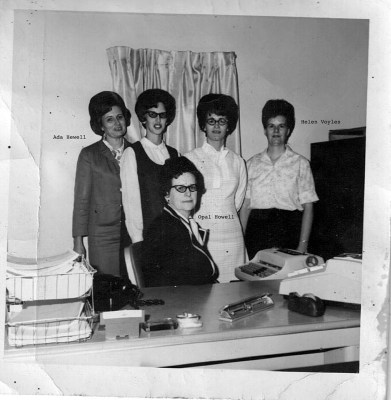
These women – Ada Hewell (a.k.a. Mother, back row, far left), Helen Voyles (a.k.a. Mama Helen, back row, far right), and Opal Howell (a.k.a. Mama Opal, seated in front) – worked together for a long, long time. At first, their office was in the red brick building at the corner of Hwy. 54 and Hwy. 85 mere feet from the Fayette County Jail. If a prisoner was deemed trustworthy, he was given the title of Trustee and sent out into the town to perform various duties like emptying trashcans, sweeping floors, moving furniture, carrying heavy things in from trucks, etc. Barring illness, Mother, Mama Helen, and Mama Opal saw the Trustee every single work day. These women got to know the Trustees. They baked them birthday cakes and bought Christmas presents for the Trustee and his family members. When the Trustee was on the eve of release, they bought new clothes and shoes for him to wear out into the world. If the Trustee became a law-abiding citizen, these women beamed with happiness for him and his loved ones. If the Trustee broke another law and wound up back in jail, these women sighed, shook their heads, and expressed their disappointment before returning their attention on the current Trustee. They were sometimes disappointed in an individual Trustee, but they never gave up on Trustees as a whole.

Here in Cashiers, N.C., a few residents quietly bought up the land at the major intersection (and site of one of our two traffic lights) and donated it to the town to form the Village Green. Local merchants and service organizations host arts and crafts shows and concerts there during the summers. There are grills, picnic tables, playgrounds, restrooms, walking paths, and more. Every other year, sculptors are invited to display one of their pieces in the Village Green. Local folks vote on their favorite, and the sculpture with the most votes is purchased and goes on permanent display at the Village Green.

Another family donated land and money to build a lovely, well-appointed library that rivals facilities located in much larger towns. During the winter, a fire burns in the fireplace in the comfortable reading room that’s located across the hall from the lovely conference room. Both rooms are available for local residents to use as needed. On the other side of the library is a large room with a raised stage that local residents can use free of charge for all sorts of things.

Citizens like this exist everywhere, but often you have to dig for the stories or maybe you just stumble across it by accident because these ordinary citizens aren’t looking for attention. They are just doing what they know is Right and Good.

When I was in undergraduate school, there were sit-ins and flag burnings and marches – all attended by people as far as the naked eye could see. A few decades later when I went to graduate school, there was much talk of activism and “the greater good”. Protests and demonstrations had to be big, involve large numbers of people, and capture media attention.

But let us never forget that:

Societal change doesn’t have to mean disruption and destruction.
Making the world a better place can mean making your community a better place.
Enkindling change doesn’t have to be splashy and noisy enough to make the 6:00 news.
Quiet activism is still activism.
And quite often, in changing one individual life, many are changed in the process.

74: My Mother’s Garden

Ada16oct15c

She inherited her mother’s green thumb
which means that no matter the soil
or sun, shadow, or rain,
she can grow anything.
Can make any plant come to life
and thrive.
“See that dogwood tree right there?” she asks.
“When Robin gave that to me,
it was about 3 inches tall
and in this little ole’ pot.
And now just look at it.”
I do look,
but I can’t see the top
because it’s too high.

Iris are her favorite flowers,
though she fancies roses
and sunflowers, too.

She likes to share her plants with others
and grow plants from seeds.
This morning we walk through her backyard
looking at what’s faded
what is still green and growing
what I might want to bring up the mountain.
She tells me on of Walter’s favorite jokes,
but I can’t remember it now.
Something about two men, one wife, and honesty.

She climbs up and over and through
her backyard,
her right knee now hugely swollen
and infected from the fall she took
three weeks ago in front of the GNC store.
“Thank goodness she didn’t hit her face,”
her friend Mama Helen tells me.

“I need to snip off some Mexican Lavender,”
Mother says. “I had some that was doing just fine,
but the men who pressure washed the house
killed it, so I need to start over.”
I like to try to root things,” she tells me.
“Some things take root, others don’t.”

~~~~~~~

And from my garden, The Daily Dahlia:

DailyDahlia16Oct15

73: Coincidence? Sign? Embodied Research? You Decide

GDHKeyChain

(The fob Granddaddy Hewell carried on his keychain)

On May 5, 1933, while my granddaddy was changing from his banking clothes to his farming clothes, came a knock at the door. Granddaddy opened the door to find four bandits who’d come to rob the bank. Even back then, the vault was on a time lock, so with nothing to do till the next day, the bandits did what I suppose makes sense to any bandit’s mentality: they held my family hostage overnight then kidnapped Granddaddy the next day. My daddy was 5 years old and the uncle I am named after was a babe-in-arms.

Times were hard in May of 1933. At 1:00 a.m. on Monday, March 6, 1933, only thirty-six hours after his inauguration (and two months before the bandits came to call on my family), President Roosevelt issued Proclamation 2039 ordering the suspension of all banking transactions for three days, effective immediately. Before the three days were over, the Banking Holiday, as it came to be called, was extended for another four days. It’s estimated that as many as 4,000 banks failed during the year of 1933 alone. Maybe because they felt they had nothing to lose, bank robbers – like Bonnie and Clyde, for example – became daring and glamorous. As they later told officials the five bandits (Four came to the door while one stayed out of sight because he was a local boy whose entire family was known to Grandmother and Granddaddy.) had aspirations of becoming famous.

I’m writing these 100 stories as a gearing up for spending next year writing the book I’ve spent my whole life working on . . . a book about this particular event in my family’s history. So imagine my surprise when I opened the mail yesterday – yesterday, I tell you – to find a letter informing me that the bank that holds my business account and safe deposit box has been declared a “failed institution” and closed by the Georgia Department of Banking and Finance.

Dear Sweet Spirit of Surprise,

If you closed the bank and sent the letter to get my attention or to give me the supportive thumbs up or to nudge me forward by giving me a deeper empathy with folks who probably didn’t receive a letter in 1933, well, you shouldn’t have gone to so much trouble.

Your Admirer and Faithful Servant,
Jeanne

72: Fall Leaves

BRP3

Yesterday we took a ride on the Blue Ridge Parkway,
and out of my memory banks fell remembrances
of how one Sunday every fall, we got up at dark thirty,
met a few families at the courthouse,
and caravaned to the mountains to see the colorful leaves.

BRP2

We stopped at a roadside picnic table,
and after lunch,
the kids took a walk in (yes, IN)
the nearby creek
while the parents relaxed and talked up a blue streak.
(The sun photobombed this photo from yesterday.)
(Which is perfectly fine.)

BRP1

My friends laughed and skipped
from stone to stone on one foot,
and I joined them . . .
for maybe two stones
before I fell into the creek.
I was clutsy, no question about that.
(And I’ve not developed physical grace with age.
I’m still unsure on my feet
when walking to the falls that are at our front door.
The Engineer says I need to put my feet down with more authority.
I say he just needs to hold my hand.)

BRP4

We never had a towel
and had usually thrown away the picnic napkins
on those childhood day trips,
so I’d just drip dry,
and shiver all the way home
despite being wrapped up in Daddy’s suit jacket.

BRP5

Now it’s true
that we went to the mountains to see the leaves,
and it’s true
that we had a picnic,
and it’s most definitely true
that I fell into the creek every darn time.
But I can’t imagine why Daddy
would wear a coat and tie for a leisurely day-long drive
through the mountains of north Georgia.
That just doesn’t make sense.

BRP6

Stories are constructed.
Memories are fallible.
Some tales are ruined by questions.
Some tales are never questioned and should be.

But that doesn’t mean stories shouldn’t be told.

« Older posts Newer posts »