+ Her Barefoot Heart

Category: Blog (Page 17 of 101)

News of The 70273 Project with a side of Jeanne’s Barefoot Heart

76: When Bandits Come to Call

SrJrGeneMontie112533001 copy

My grandparents were held hostage in their own home for two days and one night in May 1933. The bandits put on clothes that didn’t belong to them. They stole Granddaddy’s guns to add to their own formidable collection. They drank the prohibited whiskey they brought with them, imbibing till the bottles ran dry.

I wonder about so much. Oh, I have the facts – the basic facts, anyway. I can tell you the robbers’ names. Thanks to Mrs. Sarah Rivers (daughter of Mr. B. D. Adams who was sheriff at the time), I can tell you what they looked like and things they said. I can tell you when and where they were sentenced. I can show you in Mr. B. D. Adams’ own handwriting when they were brought to the Fayette County jail and when they were transferred to the Men’s State Prison Farm in Milledgeville, GA. I can even tell you how much money the bandits got and why they didn’t get more. But I wonder so many other things that I’ll never find answers for in the old newspapers or log books.

I wonder, for example, how this one event shaped me into the woman I am today. Sure, my daddy was only five years old, but I still just Know in that way that defies evidentiary proof that it helped make me the Jeanne who writes before you.

And Grandmother . . . how did it change her? She had just given birth to my Uncle Gene. Did she look to Granddaddy to do something to make the bad men go away? Did she expect him to take care of the situation, and how did she feel about him through the rest of their lives that he couldn’t do anything but let it all play out? Did that make him less of a man in her eyes? Was she disappointed? Embarrassed? Did she feel let down? Did Grandmother feel she could never rely on him ever again? Did she feel that the white horse rode right out from under her chosen knight, leaving him on the ground with his shining armor scattered in bits and pieces all around him? Or did she love him more than she ever imagined possible?

And what about Granddaddy? Did he hover in fear? Did he try to reason with the bandits? Did he challenge them in any way? How did he handle being helpless? Did he pray? Did he make deals with his God? Did he fantasize about taking one of the guns and annihilating every last one of the bandits, bringing the ordeal over much, much sooner than it actually played out? Did he know hate for the first time? Did he reassure Grandmother and if so, how – what did he say, what did he do that she found reassuring? How did he reassure himself with these trespassers in his home, holding guns to his five year old’s head? What went through his mind when they eventually kidnapped him, leaving his family there under the watchful eyes of two of the bandits? Afterwards, how long did he torment himself by replaying it in his mind, grasping at ways to change the outcome?

How did this change the relationship between Grandmother and Granddaddy as the years rolled on? Did this weekend of terror and vulnerability bind them together in ways they never thought possible or was a wedge permanently embedded?

When he went back to work at the bank, did Granddaddy approach his work differently? Over the years, people who knew Granddaddy tell me the same things about him: There wasn’t a dishonest bone in his body. He helped a lot of people. He was a good man, a real good man. Many remembered how they had come to town and forgotten the checkbook. Rather than make the long trek back home and back to town again, they went to the bank to see Granddaddy who lent them money to buy groceries and the other necessities. “Sometimes he didn’t even make me shake his hand,” they tell me, “he just loaned me the money I needed saying, ‘I know you’ll pay it back next time you come to town.'”

How did Grandmother and Granddaddy trust anybody ever again?

They were victims, there’s no argument or doubt about that. My grandparents were victims. But here’s the thing: they didn’t remain victims. They stepped right back into their lives, though surely it wasn’t the same lives they’d been living on Friday, May 5, 1933 before they answered the knock at the door. How did they go on living? What’s the magic ingredient that kept them from holding onto that victim mentality the rest of their lives? Some people seem to find it so easy to spend their lives in the big, soft victim chair, never having to take responsibility for their own lives, never holding themselves (only others) accountable for what happens to them. It’s always somebody else’s fault. They just can’t watch a break. If it weren’t for bad luck, they’d have no luck at all. Grandmother and Granddaddy had an indisputable free pass to the victim’s chair, but they didn’t take it. Why? Where did they find the meddle to go on?

The more I settle in to write this book I’ve worked on my whole life, the more I see the enormity of it. And I don’t just mean in asking questions that do not come with answers in the back of the book, though that’s surely going to be A Test. This book is going to take me places I never imagined going . . . though perhaps I’ve always secretly wanted to.

75: Bigger Is Not Automatically Better

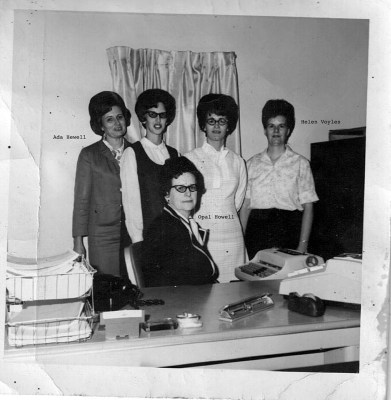
AdaOpalHelenEdithMystery2

These women – Ada Hewell (a.k.a. Mother, back row, far left), Helen Voyles (a.k.a. Mama Helen, back row, far right), and Opal Howell (a.k.a. Mama Opal, seated in front) – worked together for a long, long time. At first, their office was in the red brick building at the corner of Hwy. 54 and Hwy. 85 mere feet from the Fayette County Jail. If a prisoner was deemed trustworthy, he was given the title of Trustee and sent out into the town to perform various duties like emptying trashcans, sweeping floors, moving furniture, carrying heavy things in from trucks, etc. Barring illness, Mother, Mama Helen, and Mama Opal saw the Trustee every single work day. These women got to know the Trustees. They baked them birthday cakes and bought Christmas presents for the Trustee and his family members. When the Trustee was on the eve of release, they bought new clothes and shoes for him to wear out into the world. If the Trustee became a law-abiding citizen, these women beamed with happiness for him and his loved ones. If the Trustee broke another law and wound up back in jail, these women sighed, shook their heads, and expressed their disappointment before returning their attention on the current Trustee. They were sometimes disappointed in an individual Trustee, but they never gave up on Trustees as a whole.

Here in Cashiers, N.C., a few residents quietly bought up the land at the major intersection (and site of one of our two traffic lights) and donated it to the town to form the Village Green. Local merchants and service organizations host arts and crafts shows and concerts there during the summers. There are grills, picnic tables, playgrounds, restrooms, walking paths, and more. Every other year, sculptors are invited to display one of their pieces in the Village Green. Local folks vote on their favorite, and the sculpture with the most votes is purchased and goes on permanent display at the Village Green.

Another family donated land and money to build a lovely, well-appointed library that rivals facilities located in much larger towns. During the winter, a fire burns in the fireplace in the comfortable reading room that’s located across the hall from the lovely conference room. Both rooms are available for local residents to use as needed. On the other side of the library is a large room with a raised stage that local residents can use free of charge for all sorts of things.

Citizens like this exist everywhere, but often you have to dig for the stories or maybe you just stumble across it by accident because these ordinary citizens aren’t looking for attention. They are just doing what they know is Right and Good.

When I was in undergraduate school, there were sit-ins and flag burnings and marches – all attended by people as far as the naked eye could see. A few decades later when I went to graduate school, there was much talk of activism and “the greater good”. Protests and demonstrations had to be big, involve large numbers of people, and capture media attention.

But let us never forget that:

Societal change doesn’t have to mean disruption and destruction.
Making the world a better place can mean making your community a better place.
Enkindling change doesn’t have to be splashy and noisy enough to make the 6:00 news.
Quiet activism is still activism.
And quite often, in changing one individual life, many are changed in the process.

74: My Mother’s Garden

Ada16oct15c

She inherited her mother’s green thumb
which means that no matter the soil
or sun, shadow, or rain,
she can grow anything.
Can make any plant come to life
and thrive.
“See that dogwood tree right there?” she asks.
“When Robin gave that to me,
it was about 3 inches tall
and in this little ole’ pot.
And now just look at it.”
I do look,
but I can’t see the top
because it’s too high.

Iris are her favorite flowers,
though she fancies roses
and sunflowers, too.

She likes to share her plants with others
and grow plants from seeds.
This morning we walk through her backyard
looking at what’s faded
what is still green and growing
what I might want to bring up the mountain.
She tells me on of Walter’s favorite jokes,
but I can’t remember it now.
Something about two men, one wife, and honesty.

She climbs up and over and through
her backyard,
her right knee now hugely swollen
and infected from the fall she took
three weeks ago in front of the GNC store.
“Thank goodness she didn’t hit her face,”
her friend Mama Helen tells me.

“I need to snip off some Mexican Lavender,”
Mother says. “I had some that was doing just fine,
but the men who pressure washed the house
killed it, so I need to start over.”
I like to try to root things,” she tells me.
“Some things take root, others don’t.”

~~~~~~~

And from my garden, The Daily Dahlia:

DailyDahlia16Oct15

73: Coincidence? Sign? Embodied Research? You Decide

GDHKeyChain

(The fob Granddaddy Hewell carried on his keychain)

On May 5, 1933, while my granddaddy was changing from his banking clothes to his farming clothes, came a knock at the door. Granddaddy opened the door to find four bandits who’d come to rob the bank. Even back then, the vault was on a time lock, so with nothing to do till the next day, the bandits did what I suppose makes sense to any bandit’s mentality: they held my family hostage overnight then kidnapped Granddaddy the next day. My daddy was 5 years old and the uncle I am named after was a babe-in-arms.

Times were hard in May of 1933. At 1:00 a.m. on Monday, March 6, 1933, only thirty-six hours after his inauguration (and two months before the bandits came to call on my family), President Roosevelt issued Proclamation 2039 ordering the suspension of all banking transactions for three days, effective immediately. Before the three days were over, the Banking Holiday, as it came to be called, was extended for another four days. It’s estimated that as many as 4,000 banks failed during the year of 1933 alone. Maybe because they felt they had nothing to lose, bank robbers – like Bonnie and Clyde, for example – became daring and glamorous. As they later told officials the five bandits (Four came to the door while one stayed out of sight because he was a local boy whose entire family was known to Grandmother and Granddaddy.) had aspirations of becoming famous.

I’m writing these 100 stories as a gearing up for spending next year writing the book I’ve spent my whole life working on . . . a book about this particular event in my family’s history. So imagine my surprise when I opened the mail yesterday – yesterday, I tell you – to find a letter informing me that the bank that holds my business account and safe deposit box has been declared a “failed institution” and closed by the Georgia Department of Banking and Finance.

Dear Sweet Spirit of Surprise,

If you closed the bank and sent the letter to get my attention or to give me the supportive thumbs up or to nudge me forward by giving me a deeper empathy with folks who probably didn’t receive a letter in 1933, well, you shouldn’t have gone to so much trouble.

Your Admirer and Faithful Servant,
Jeanne

72: Fall Leaves

BRP3

Yesterday we took a ride on the Blue Ridge Parkway,
and out of my memory banks fell remembrances
of how one Sunday every fall, we got up at dark thirty,
met a few families at the courthouse,
and caravaned to the mountains to see the colorful leaves.

BRP2

We stopped at a roadside picnic table,
and after lunch,
the kids took a walk in (yes, IN)
the nearby creek
while the parents relaxed and talked up a blue streak.
(The sun photobombed this photo from yesterday.)
(Which is perfectly fine.)

BRP1

My friends laughed and skipped
from stone to stone on one foot,
and I joined them . . .
for maybe two stones
before I fell into the creek.
I was clutsy, no question about that.
(And I’ve not developed physical grace with age.
I’m still unsure on my feet
when walking to the falls that are at our front door.
The Engineer says I need to put my feet down with more authority.
I say he just needs to hold my hand.)

BRP4

We never had a towel
and had usually thrown away the picnic napkins
on those childhood day trips,
so I’d just drip dry,
and shiver all the way home
despite being wrapped up in Daddy’s suit jacket.

BRP5

Now it’s true
that we went to the mountains to see the leaves,
and it’s true
that we had a picnic,
and it’s most definitely true
that I fell into the creek every darn time.
But I can’t imagine why Daddy
would wear a coat and tie for a leisurely day-long drive
through the mountains of north Georgia.
That just doesn’t make sense.

BRP6

Stories are constructed.
Memories are fallible.
Some tales are ruined by questions.
Some tales are never questioned and should be.

But that doesn’t mean stories shouldn’t be told.

71: He Called me Doll

JeanneDad

He was caught up in what I call the medical pinball machine, bouncing from one doctor to another. To look on the patients’ faces in the waiting rooms was to see people whose identity was now invested in their health. Or, more specifically, lack of it. We’d exit the exam room, and every patient in the waiting area looked at us expectantly. “When do you have to come back?” was the sorting question. Say you didn’t have to come back for six months or a year, and everybody sat back in their chair and turned their attention back to their magazine. Say you had to come back in three months or less, and they moved even closer to the front edge of their chairs, sat up straighter, and ooo-ed and aah-ed in a kind of envy or respect. Three months or less meant you were Really Sick, you see, and these people had an illness rating system that didn’t cotton to imposters. Daddy was on the every-three-months plan with the cardiologist, which is to say he was well respected in that waiting room.

I turned the appointments into a Social Occasion, letting Mother invite a friend and taking everybody to a new restaurant after the carefully-timed mid-morning appointment. On this particular day, Mother invited Miss Eleanor Jones to go with us. Daddy sat up front with me, and the girls sat in the backseat so they could talk – or “visit”, as Aunt Rene would say. Anticipation is part of the fun, so I told them I was taking them to Athens Pizza for lunch on that bright, sunny springtime day. Daddy was excited about it, but something changed after his appointment, and he turned grumpy and didn’t want to go. “Just take me home,” he said. “You can take them to eat somewhere in Fayetteville after you take me home.” Mother and Miss Eleanor were disappointed, but not to worry. I drove straight to Athens Pizza, telling Daddy he could sit in the car and assuring him we’d eat fast.

My made-on-the-fly plan called for me to park in the sunshine, leaving Daddy in the car with the windows up. Mother and Miss Eleanor wrung their hands and clucked with concern, but Br’er Jeanne just ushered them right on into the restaurant where the hostess greeted us.

“How many are in your party?” she asked.

“There are three . . . now,” I told her looking at my watch, “but there’ll be a fourth joining us in, oh, about fifteen minutes.”

Only then did Mother and Miss Eleanor relax.

We were shown to our table, and I moved a chair to make room for Daddy’s eventual wheelchair. We ordered our drinks, and, even though it hadn’t been 15 minutes, I decided Daddy was just about fully baked, so I excused myself and headed for the car. Daddy saw me the minute I rounded the corner, and made ready to get out. I wheeled him in, and we all enjoyed a leisurely and delicious Greek salad and pizza. Years later Daddy asked me to take him back to Athens Pizza, and on the way, I told him the rest of the story about that first visit. He laughed and laughed and laughed then said, “You know me better than I know myself, don’t you, Doll?”

Which wasn’t really a question, you know.

~~~~~~~

DailyDahlia13Oct15

Today’s Daily Dahlia

~~~~~~~

70: Forever Blooming

GMHBDHJeanneInClover

Gardening was something my Granddaddy Hewell flat-out loved doing. He had no sense of landscape design, but he had two green thumbs, and that’s enough because as a little girl, I didn’t give a twit about what was planted where, I only cared about spending time with my granddaddy.

He grew day lilies, and it seemed to me as I stood there beside him surveying the back yard, that they went on forever (or at least into the next county). They certainly filled the land as far as my little 3′ high eyes could see. Every day after work during day lily season, Granddaddy came home, changed from his banking clothes to his gardening clothes, and we headed out to deadhead, plucking the spent blooms and tossing them in a trashcan. We told each other the highs and lows of our day, and once that was done, we worked silently. Side by side.

Granddaddy had a greenhouse – a real glass greenhouse – with raised tables and a hose and spigot and everything. Inside those four glass walls, he started seeds to give them a head start on life, and nursed ailing plants back to health. One year we spent the afternoon of his birthday working in the greenhouse, Granddaddy stood on the ground, his hands busy in the dirt, while I stood on an upturned wooden box next to him asking questions (many of which began with “Why?” or “What if?”) and, every now ‘n then, fetching him what he needed.

Mother, Daddy, and I had recently moved into Granddaddy and Grandmother’s house to help Granddaddy tend to Grandmother who’d had several strokes and had to have everything done for her. While we worked in the greenhouse that day, Mother was in the kitchen, and before Granddaddy and I even knew we were hungry, she hand delivered two of the most beautiful cakes you’ve ever seen: a birthday cake with chocolate icing and yellow embellishments for Granddaddy and a kid-sized matching cake for me.

His whole face broke into a smile, and he did that little understated chuckle that meant he was very pleasantly surprised. Me, I danced a happy, happy, happy jig. It was Granddaddy’s birthday, and I got a cake! Mother had never made me a Jeanne-sized cake before, and I liked it. I liked it a lot. So as we ate our birthday cakes right there in the greenhouse (Mother didn’t even make us go inside and wash our hands!) I posed what was likely the best idea I’ve ever had: I suggested that Granddaddy have a birthday every . . . single . . . day. Though he didn’t say it in so many words, I could tell he wasn’t so keen on the idea, but I believe given half a chance, I could’ve sold it to Mother.

69: Bounty

GDAtBarn

Now I’m not saying he was set in his ways or anything, but it was around 1971 before Granddaddy Ballard got rid of his mule. In this photo, we see him about to fetch the mule to go prepare the spring garden. Isn’t it adorable the way he almost has to reach up to unlatch the gate? He’d plow the garden plot behind the house, creating straight rows in which he’d plant corn, butterbeans, potatoes, tomatoes, squash, cucumbers, and string beans. Though the mule dwarfed Granddaddy, they made a good team, working together to make a neat, bountiful garden.

And I’m not saying she was set in her ways or anything, but every morning for I don’t know how many years, his daughter/my mother Ada stopped by on her way to work. She seldom stayed long enough to sit down. She’d just ask how he slept, see if he needed anything from town, give him a hug, and be on her way. Before she got out the back door, Granddaddy always put something in her hand. It might have been an apple, a peach, a Three Musketeers candy bar, but she never left his house empty-handed.

One year when she stopped by on her birthday, she left with an apple, a $100 bill, and a story . . .

“Now lookahere, Ada,” he started out. “You’ve always thought I named your after my mule, but let me tell you something once and for all: I didn’t. I named your after my mother. But if you want to keep on believing that I named you after my mule, fine. Just know this, though: of all the mules I ever had, Ada was by far my favorite because she was the easiest going, least stubborn, hardest working, even tempered, most reliable, best damn mule that ever walked the face of this earth.”

AdaElviraLuckieSamsBalla001 copy

Ada Elvira Lucky Ballard Sams,
my great grandmother

68: Social Promotion Is Alive and Well (in Some Classrooms, Anyway)

JeanneBabyPhoebe copy

The Engineer believes in letting a dog be a dog, but because I wanted to occasionally take Phoebe outside the house, I (strongly) suggested we take her to doggie school. The first week of an 8-week class, the teacher said she’d always wanted a Corgi, and by the second week of class, she had one named Callie. Callie and Phoebe became fast, dear friends at first meeting. We’d walk in the front door, Phoebe would spot Callie, Callie would spot Phoebe, and the two would run towards each other with great, huge excitement. They’d begin to enthusiastically wrestle play in the center of the classroom, occasionally sitting back to catch their breath, and they didn’t stop until class was over. The Engineer and I just watched the other dogs perform their homework and learn next week’s lesson.

PhoebeSanta

Long about week five, we entered the building and, as usual, Phoebe and Callie raced towards each other and began playing in the center of the circle. When they sat back to take a breathing break, Phoebe looked around at her other classmates, saw them sitting with their nose about seven inches from a treat (It was “wait for it” week.), and thought to herself, “Well, if you don’t want it, I do” then ran around the circle snatching every single treat from every single dog.

It took a whole lot of apples to get her socially promoted.

Phoebe1

67: Leopold

IMG 0321 copy

We’d just moved into the new house, so workers are bustling around everywhere. One morning while bringing materials in, a worker looks at me and asks, “Did you know you have a bat in the house?”

“No, where?”

“Up there,” he says, nodding in the direction of the vaulted ceiling in the gathering room. I look around but see nothing, so when he comes back out after dropping off the materials, he points. Following his finger with my eyes, I see a small black spot. He assures me it’s a bat, and I immediately know the source of that high-pitched keening I heard when The Engineer left for work that morning.

My daughter is amused and names the bat Leopold. You can call me a fool, but I’m just not comfortable having a bat inside my house – cute name or no – so I call my pest control contractor. “John,” I say, “there’s a bat in my house. Can you come relocate him?”

“There’s nothing I can do about bats,” he tells me, “but I can tell you what to do, and it’s not hard. Get a stocking and stuff a couple of your husband’s socks down into the toe. Bats work on a kind of radar, you see, so go open the nearest door then sling the stocking with the socks in the toe around and around and around in a circle. The bat will feel the breeze, get the picture, and fly out of the house.”

“John, that’s never gonna’ work,” I complain.

“It’s not hard,” he assures me, and he starts over. “Just get a stocking and stuff a couple of your husband’s socks down into the toe, then open a door, sling the sock-stuffed stocking . . . ”

“Stop right there, John. That’s why your method is not going to work.”

“Huh?”

“Where on earth am I gonna’ find a stocking?”

~~~~~~~

I spent part of every day trekking down memory lane and telling stories here in this e-nest. If you’d like to read along, why don’t you just mash the “right this way” button in the orange ribbon at the top of the screen and follow the directions. It’s free, quick, easy, and mutely appreciated.

« Older posts Newer posts »